Westosha Central High Students Earn Sawblade Certificates

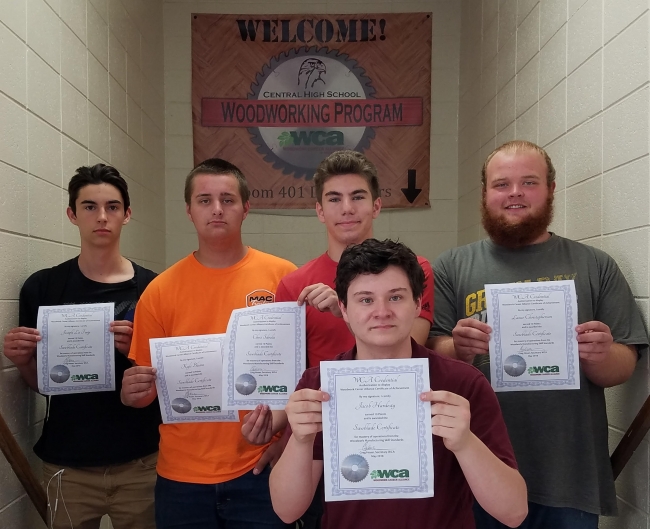
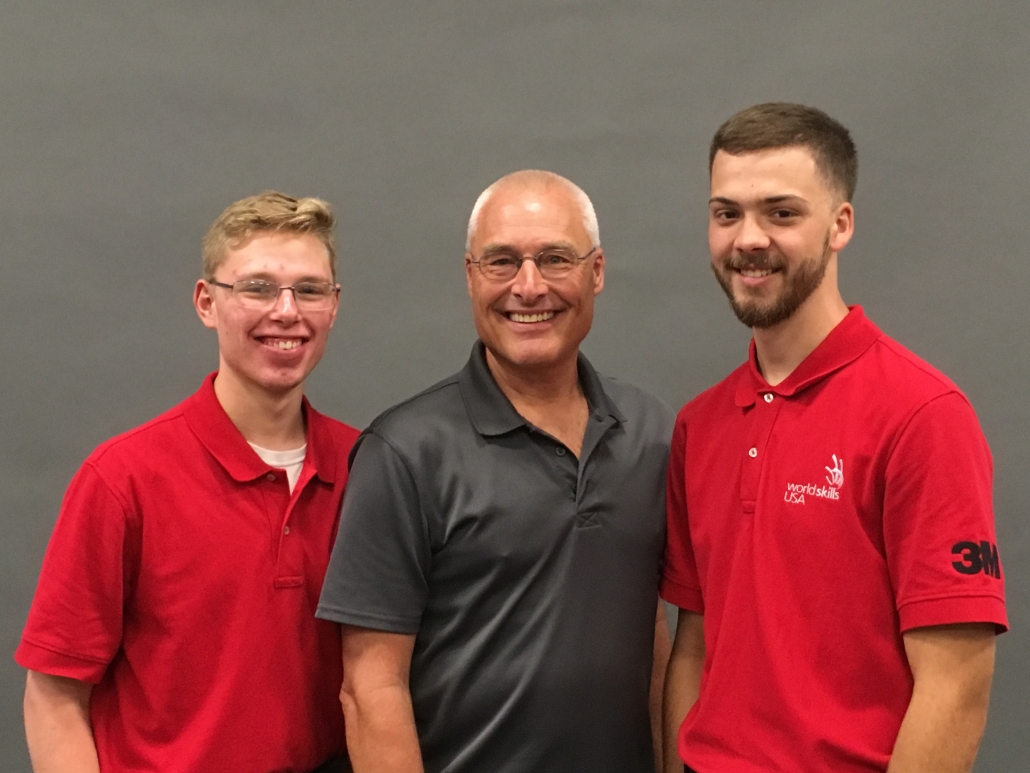
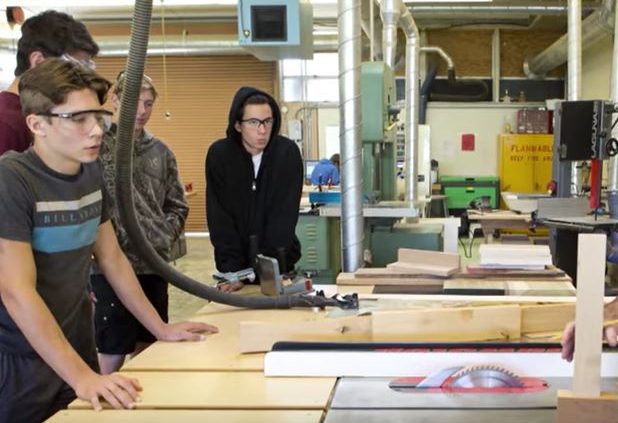
Among the woodworking students at Westosha Central High School of Salem, WI, who received their WCA Sawblade certificates were these five who showed up on the last day of the 2017-18 school year: Joseph La Jorge, left, Kyle Blume, Chris Sdralis, Jacob Hardesty and Lance Christopherson.

The students earned their Sawblade certificates by mastering basic woodworking skills in the award-winning program instructed by Bert Christensen.

Christensen was profiled in the Fall 2017 issue of Pathways. Read the article.

Idaho Cabinetmaking Student Russia Bound for WorldSkills

Ethan Harrison, a 2018 graduate of Blackfoot High School of Blackfoot, ID, will represent the United States in the biennial WorldSkills cabinetmaking competition Aug. 22-27, 2019 in Kazan, Russia.

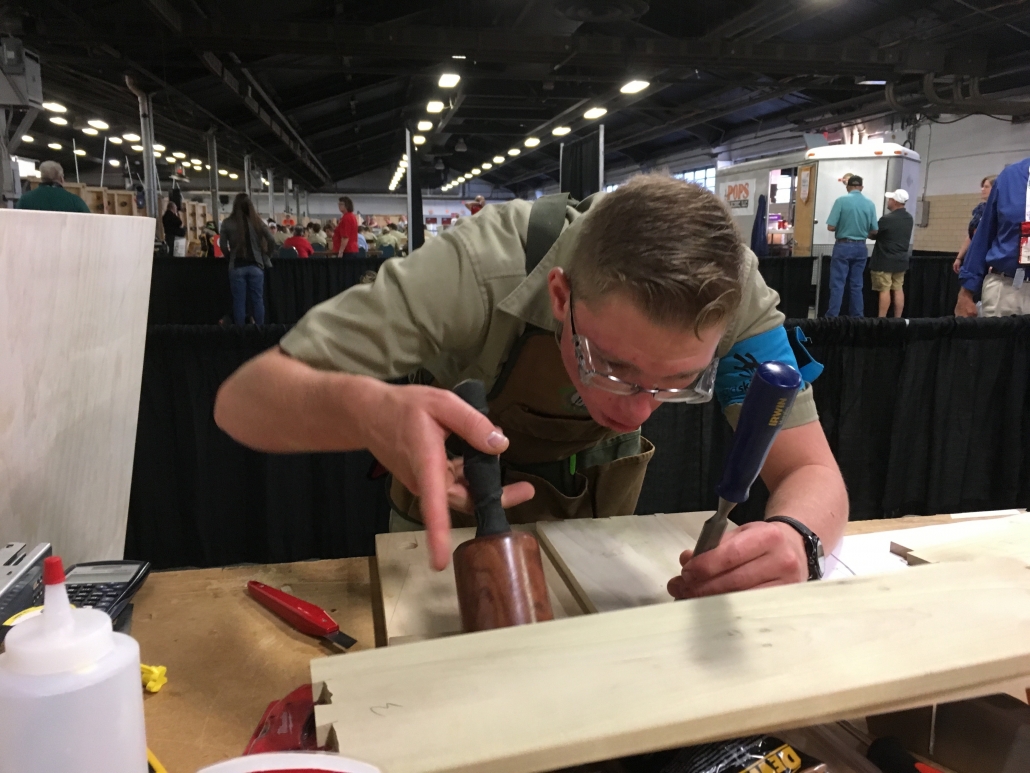
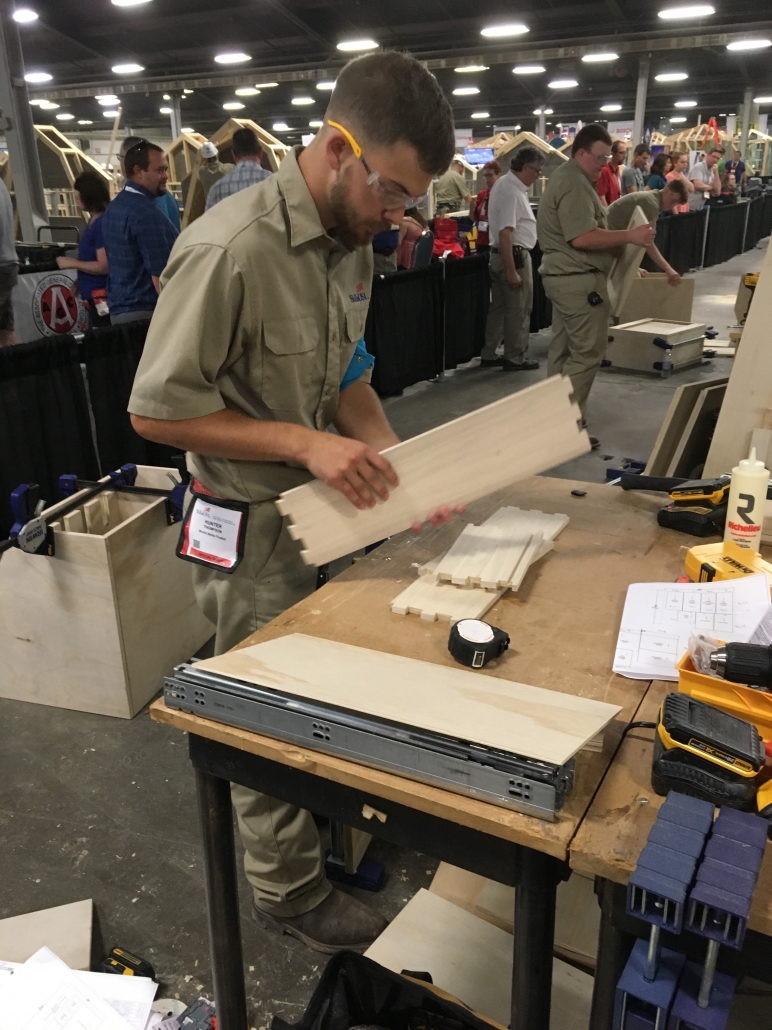
Harrison earned the honor by winning a head-to-head competition at SkillsUSA last month in Louisville, KY. Runner-up, Hunter Thompson, a 2016 graduate of Cedar Ridge High School of Hillsborough, NC, will serve as the alternate if Harrison is unable to compete in WorldSkills 2019.

First held in 1950 in Madrid, WorldSkills aims to “raise the profile and recognition of skilled people and show how important skills are in achieving economic growth and personal success.”

“Both Ethan and Hunter did an excellent job in the run-off,” says Jeff Molzahn, a woodworking instructor at Madison College and newly appointed WorldSkills cabinetmaking advisor for SkillsUSA. In that advisory role, Molzahn will coach Harrison as he prepares for WorldSkills. He says he plans to build Harrison’s training program around the Woodwork Career Alliance’s skill standards.

“One of my goals is that Ethan will earn his WCA Green Credential during his WorldSkills training,” says Molzahn, a WCA accredited skills evaluator. “I think the WCA skill standards and evaluation process will dovetail nicely to get ready for WorldSkills. When you are getting your certification, you have an evaluator watching you work. While you might be really good on a table saw or other equipment, it’s a different experience having someone standing over and judging you. I think that experience will go a long way to help prepare Ethan for the pressure he will face on the big stage in Kazan.”

Both Harrison and Thompson qualified for WorldSkills by virtue of their solid placing in recent SkillsUSA competitions. Thompson won a gold medal in 2016. Harrison won silver in 2017.

Harrison says he only began learning woodworking as a sophomore at Blackfoot High School. His instructor, Peter Golinveaux, quickly realized his potential and encouraged him to compete in the state SkillsUSA competition. “He was my mentor and helped me with any question I had,” Harrison says. “I have really come to love woodworking; it helps me de-stress.”

Harrison says he prepared for WorldSkills using hand tools he purchased with scholarship money established in the honor of Rhett Fields, a Blackhawk High student who died in a motorcycle accident at age 17.  “Rhett was supposed to go to SkillsUSA nationals then he had his accident,” Harrison says. “He really inspired me and I really wanted to win this for him.”

Preparing for WorldSkills will dominate Harrison’s life during the next year. After the competition he plans to do missionary work then attend college. “I plan to build furniture to pay tuition,” Harrison says. “After I graduate I would like to have my own custom furniture shop making rocking chairs, tables and other one-of-a-kind pieces.”

Thompson already has a WCA Green Credential and is working toward his Blue Credential. He studied woodworking for four years under Keith Yow, woodworking instructor at Cedar Ridge High School, a WCA EDUcation member. “The WCA Passport program was a good structure to build my skills on,” Thompson says. “Mr. Yow, my instructor, was very helpful in my development and a great role model throughout my high school years.”

Thompson just completed his associate’s degree at Alamance Community College and will enter North Carolina State University as a junior this fall to pursue a degree in sustainable materials and technology. Upon graduating he wants to get a work for a large woodworking company. His ultimate goal is to run own furniture and cabinet business.

“Just being a finalist for WorldSkills was wonderful,” Thompson says. “It will look great on my resume.”

2018 SkillsUSA Medalists
In addition to the WorldSkills qualification contest, SkillsUSA featured the annual Cabinetmaking competition for postsecondary and high school students from around the country.

Winning medals at the college level were:
Gold — Alex Hamacher, Washburn Tech of Topeka, KS.

Silver — Andrew Dearing, Utah Valley University of Orem, UT.

Bronze – Johnathan Schnyder, Jefferson Community & Technical College of Louisville, KY. Jefferson College is an EDUcation member of the WCA.

Winning medals at the high school level were:
Gold – Bradlee Benjamin, Berks CTC – East Campus of Oley, PA.

Silver – Tyler McLaughlin of Yutan Public Schools, Yutan, NE.

Bronze – Ravindra Dave of Cary High School of Cary, NC.

Joe Davis Named 2018 WMIA Educator of the Year


Joe Davis, with one of his many award-winning students.

Joe Davis, woodworking instructor at the Dale Jackson Career Center, of Lewisville, TX, received the 2018 Educator of the Year Award from the Woodworking Machinery Industry Association.

Davis is an accredited skills evaluator of the Woodwork Career Alliance of North America; his program is a founding WCA EDUcation member. High school students who take a third semester in the DJCC woodworking program are introduced to the WCA skill standards and Passport program with the opportunity to earn a Sawblade Certificate. Many of Davis’ students have gone on to lead successful careers as woodworkers.

Davis received the Wooden Globe Award for being an outstanding woodworking educator during the 2018 Woodworking Industry Conference in Maui. He was nominated by Erich Mazurek, president of Maze Machinery. 


Contestants Wanted for WCA Bandsaw Skills Challenge at IWF

Competition will put real-world woodworkers to the test in a virtual reality world.

Nellysford, VA – Woodworkers attending the International Woodworking Fair in Atlanta, can compete for prizes and bragging rights by entering the WCA Bandsaw Skills Challenge. The competition will be held all four days of the show, Aug. 22-25, at the Woodwork Career Alliance of North America’s booth #4154.

Through special arrangement with Mimbus, contestants will put their bandsaw skills to the test by operating the Wood-Ed Table, a virtual reality training system. Mimbus Inc. of Chicago, IL, created the Wood-Ed Table as a training tool to teach students and novices how to operate basic woodworking machinery in a safe, dust-free environment. In addition to the bandsaw, the Wood-Ed Table features three other woodworking machinery simulation modules: a ripsaw, jointer, and shaper.

“The Bandsaw Skills Challenge will be a great way to attract woodworkers into our booth and spark conversations about the WCA’s Woodworking Skill Standards and credential Passport program,” said Scott Nelson, president of the WCA. “It will be fun to watch contestants operate a virtual reality bandsaw that functions much like the real thing but without the sawdust.”

The WCA Bandsaw Skills Challenge will be held continuously at the WCA’s booth. Participants will don a virtual reality headset and complete a brief bandsaw exercise on the Wood-Ed Table. The Vulcan software that operates the Wood-Ed Table will score each contestant on cutting regularity, hand positioning, time management and more. A leader board will highlight the competition’s high scores.

Workforce Development Seminar
The WCA also will showcase its woodworking skill standards and programs through its participation in IWF’s educational conference.

The WCA will present, “Growing Your Skilled Workforce,” 10:30 a.m. to noon Wednesday, Aug. 22. The seminar will pair Nelson with Kent Gilchrist, director of operations and design for Purposeful Designs of Indianapolis, IN. The presenters will discuss how to use the WCA Woodworking Skill Standards and training resources to train new hires and develop the skills of current employees. Learn more and register at iwfatlanta.com.

###

About the Woodwork Career Alliance
The Woodwork Career Alliance of North America was founded in 2007 as a 501C(3) non-profit corporation and is governed by a volunteer board of directors. The WCA’s mission is to develop and administer a unified set of Skill Standards for the wood products industry. Since 2011, WCA has developed observable and measurable performance standards and assessments for more than 240 woodworking machine operations. In addition, WCA has issued more than 1,600 Passports, a portable, personal permanent record documenting each holder’s record of achievements as a woodworking professional. More than 100 high schools and post-secondary schools throughout North America are WCA EDUcation® members. To learn more about the WCA and how to get involved with its programs, including sponsorship opportunities, visit WoodworkCareer.org.

Harbor Freight to Begin Accepting Apps for $1M Teacher Prize May 16

CALABASAS, CA — Harbor Freight Tools for Schools announced it will award more than $1 million in cash prizes to outstanding public high school skilled trades teachers and programs, doubling the amount awarded for last year’s Harbor Freight Tools for Schools Prize for Teaching Excellence.

The 2018 prize will honor 18 public high school skilled trades teachers and their programs with $1 million in cash awards. Three first-place winners will each receive $100,000, with $70,000 going to the high school skilled trades program and $30,000 to the individual skilled trades teacher or teacher team behind the winning program. The 15 second-place winners will each be awarded $50,000, with $35,000 going to the high school program and $15,000 to the teacher/team.

The Harbor Freight Tools for Schools Prize for Teaching Excellence was started in 2017 by Harbor Freight Tools Founder Eric Smidt to recognize outstanding instruction in the skilled trades in U.S. public high schools that inspires students to learn a trade that prepares them for a career after high school. The inaugural prize awarded more than $500,000 in prizes to three first- and seven second-place winners. It drew nearly 700 applications from 48 states from a wide range of skilled trades instruction, including automotive technology, welding, carpentry, agriculture mechanics, advanced manufacturing and marine systems technology.

“We were overwhelmed by the response and the extraordinary pool of applicants last year and wanted to award more money to more skilled trades teachers to advance the important work that they’re doing in our public high schools,” Smidt said. “These inspiring educators are passionate about teaching their students life skills and trades skills they can take beyond the classroom and into solid careers, many right out of high school, that will help drive our economy.”

The prize is designed to recognize outstanding skilled trades instruction and give teacher applicants access to ideas and practices through a network of like-minded exceptional educators. The digital application for the prize solicits creative responses to a series of online expert-led video learning modules designed to help skilled trades teachers be more effective in the classroom.

“This is not a traditional teaching prize,” said Danny Corwin, executive director of Harbor Freight Tools for Schools. “We are looking for teachers who are not only accomplished skilled trades educators in teaching and inspiring their students but also are lifelong learners themselves, seeking to continuously improve their classroom practices.”

The need for skilled trades professionals in the U.S. is urgent and growing. The Bureau of Labor Statistics predicts that by 2024, there will be more than 1.5 million skilled trades job openings as Baby Boomers retire.

For more information and to register, visit https://hftforschoolsprize.org/.  Applications open on May 16 and are due July 6, 2018. The applicants with the top 50 scores will be announced as semi-finalists on Aug. 15, and the first- and second-place winners will be announced on Nov. 15. Updates on the prize will be posted on Facebook, Instagram and Twitter.

Each round of winners will be selected by separate panels of judges. Harbor Freight Tools for Schools does not select the first- or second-place winners.

About Harbor Freight Tools for Schools
Harbor Freight Tools for Schools is a program of The Smidt Foundation, established by Harbor Freight Tools Founder Eric Smidt, to support the advancement of skilled trades education in America.  With a deep respect for the dignity of these fields and for the intelligence and creativity of people who work with their hands, this program was created to foster and shine a light on excellence in skilled trades education in public high schools. Believing that access to quality skilled trades education gives high school students pathways to graduation, opportunity, good jobs and a workforce our country needs, Harbor Freight Tools for Schools aims to stimulate greater understanding, support and investment by public entities and others in skilled trades education.  Harbor Freight Tools is a major supporter of the Harbor Freight Tools for Schools program. For more information, visit https://harborfreighttoolsforschools.org.

For additional info, including a video featuring 2017 winners, click here.

Stiles Machinery Presents Solid Wood Technology Forum at Madison College

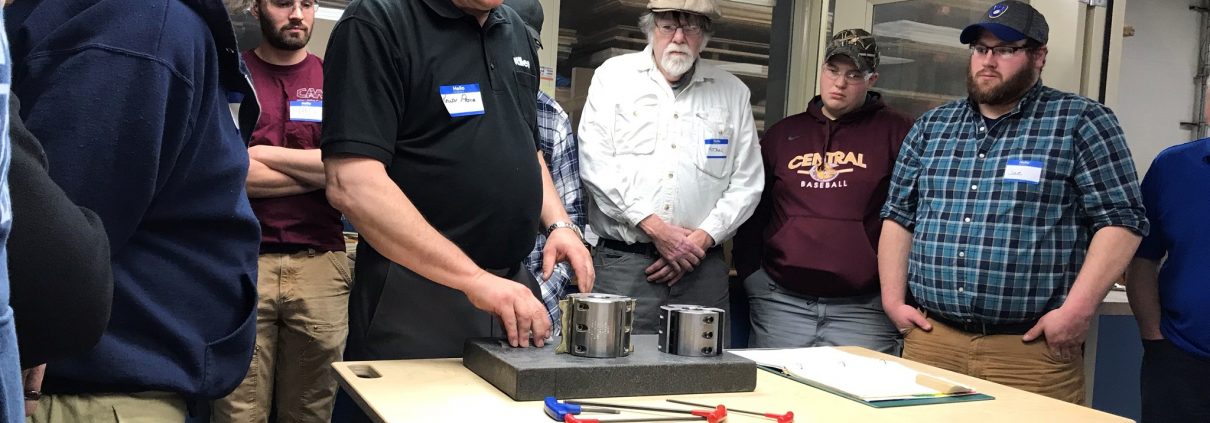
Stiles Machinery field service rep Kevin Price demonstrates moulder calibration and setup.

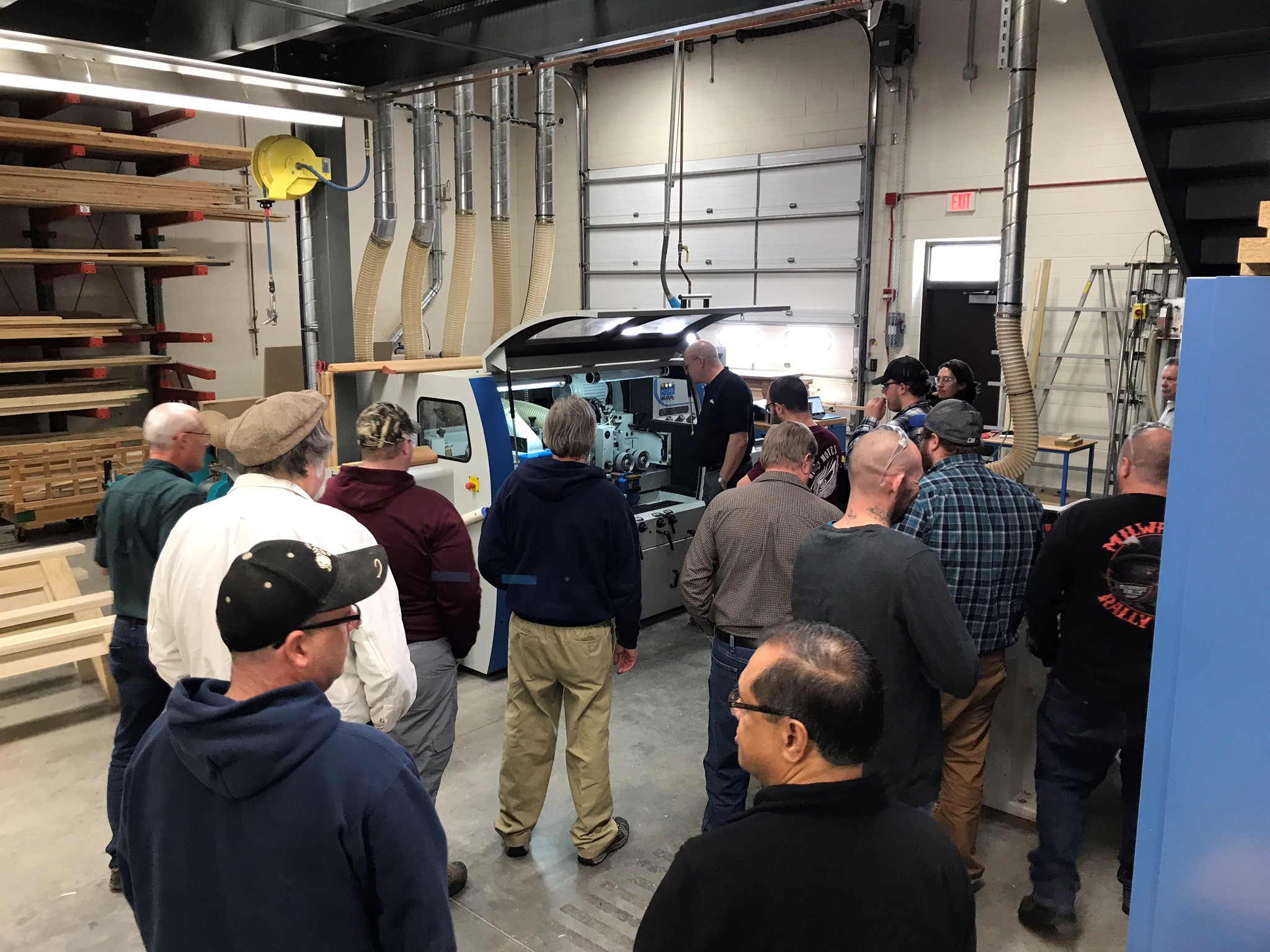
More than 40 individuals from industry and education gathered at a recent lunch and learn sponsored by Stiles Machinery and held at Madison College, Madison, WI. Participants spent the day learning about technology and practical applications for working with solid wood, as well as networking with current students.

Stiles product specialist Peter Van Dyke kicked the day off with an overview of the modern rough mill and highlighting multiple types of machinery that can be used to efficiently process wood. Following that presentation, participants were divided into groups and received more theoretical information from Van Dyke and practical demonstrations from Stiles field service rep Kevin Price on handling and preparing tooling, profile knife grinding, and moulder calibration and setup.

The Cabinetmaking program at Madison College is a Woodwork Career Alliance (WCA) EDUcation™ member and hosts several seminars annually open to industry members. To receive notification of future events, contact Patrick Molzahn at 608-246-6842 or pmolzahn@madisoncollege.edu.

Scott Nelson president Woodwork Career Alliance of North America

President’s Message: Maine State Prison, SkillsUSA & Other Updates

Since our last edition of Pathways, WCA has added eight new EDUcation™ members and five new INDustry™ sponsors.  Please check out our new members listed in the Welcome New Members section of Pathways. The INDustry Sponsorship category is designed to provide a way for manufacturers and distributors of woodworking machinery and supplies and other industry stakeholders to cost-effectively support the WCA and its EDUcation members. Visit our website  to discover which level of sponsorship best fits your company. Sponsorship fees range from $250 for Sawblade level to $1,000 for Gold.

In WCA MANufacturing™ news, the pilot Passport program at the Maine State Prison Industries that we featured in Fall 2017 Pathways is moving forward. Twenty-three inmates have completed the layout sections and are well on their way in obtaining the Green Credential. In addition, Jefferson Millwork of Sterling, VA, featured in Pathways Summer 2017, has successfully brought one of its employees to the Red Credential.  I truly applaud Jefferson Millwork for their ongoing efforts to achieve a trained work force.

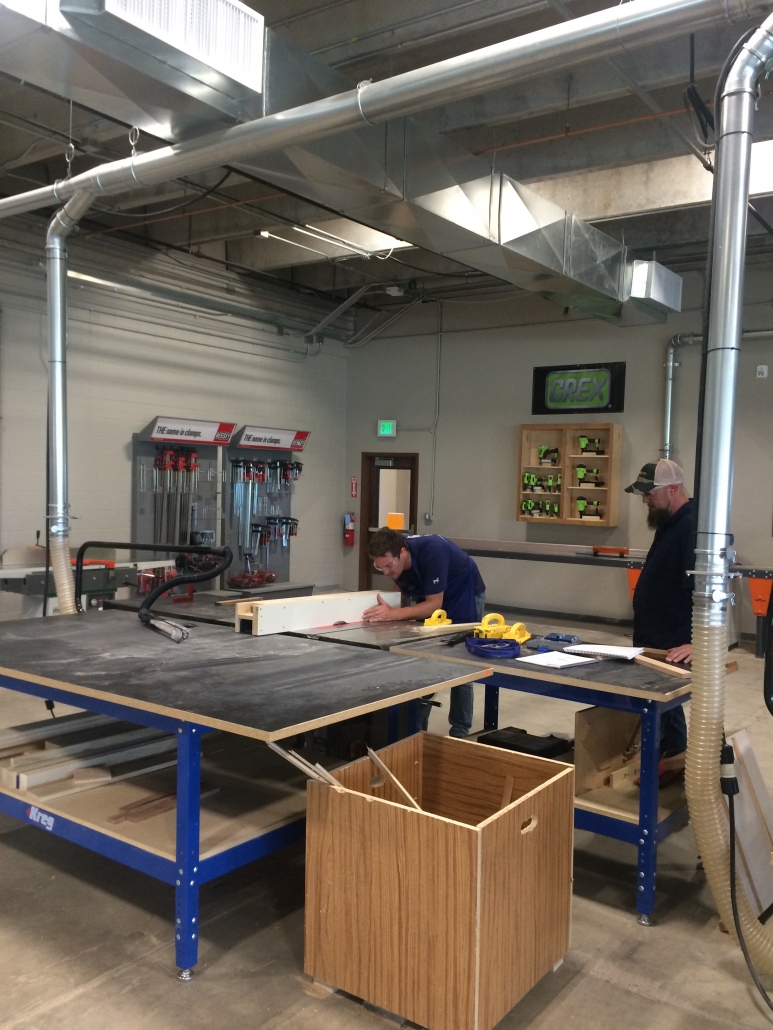
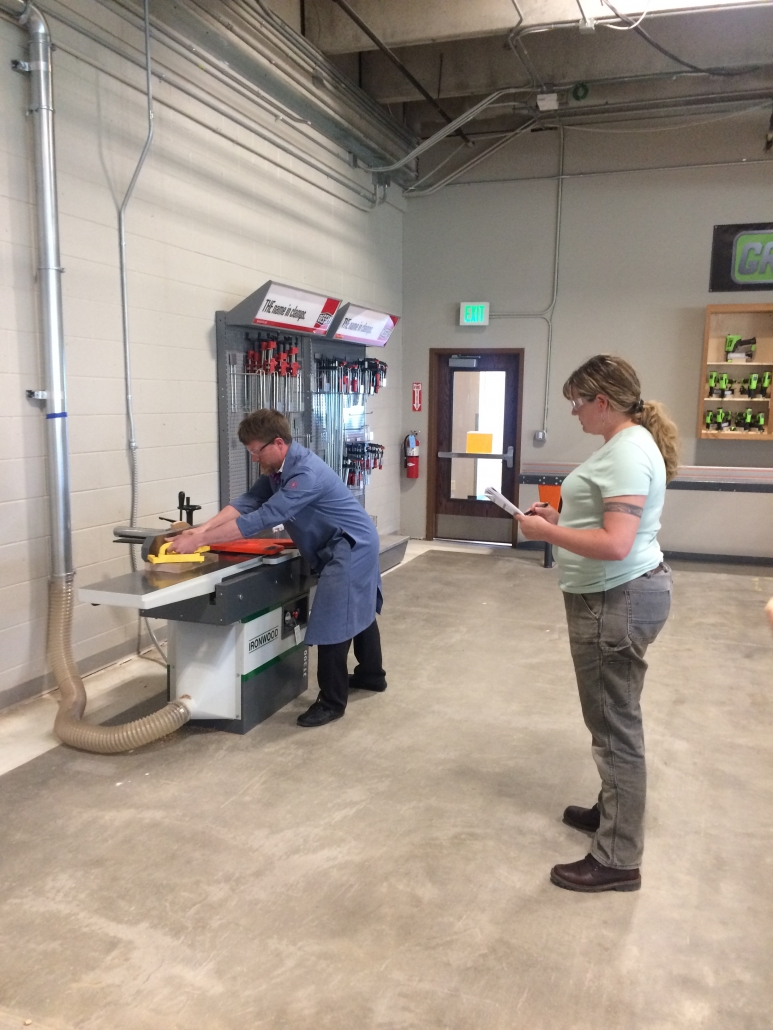
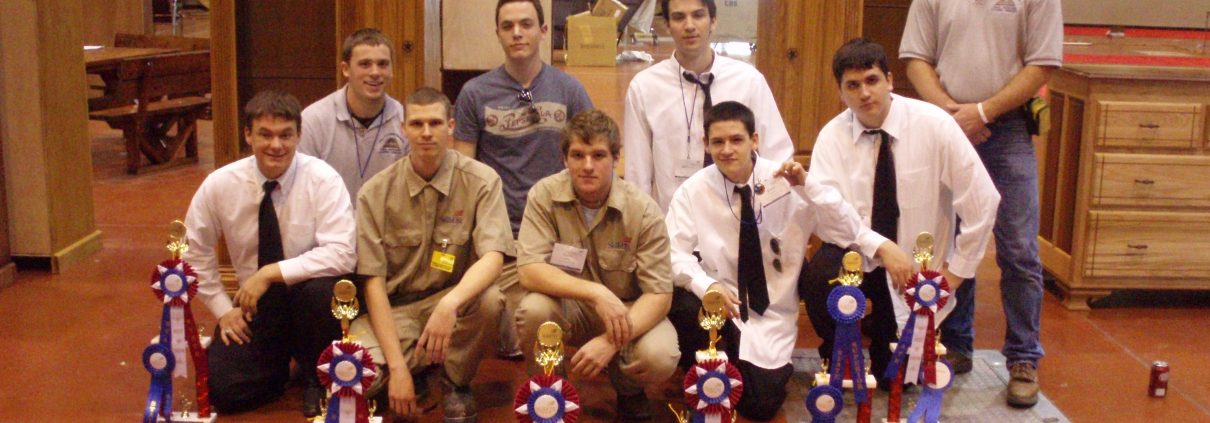
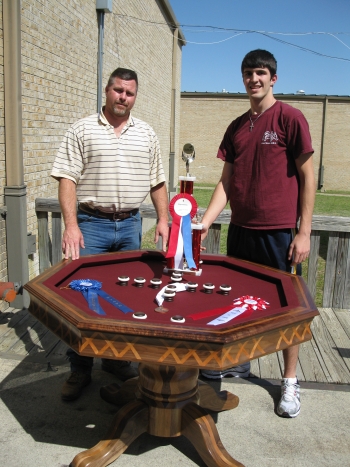
Things are very busy this time of year for many of our EDUcation members.  There is a lot of activity with the testing of students for their Sawblade certificate and for participating in state SkillsUSA competitions. I helped with the Nebraska Cabinetmaking Competition and was very pleased with the talent exhibited by these young individuals. We had 25 competitors from high schools and 10 competitors from postsecondary schools. I’ve included a few photos from the competition in this post.

Congratulations and good luck to Tyler McLaughlin of Yutan Public Schools, Yutan, NE, and Derek Summers of Wayne State College, Wayne, NE. They are moving on to represent Nebraska in the 54th annual SkillsUSA National Leadership and Skills Conference, June 25-29 in Louisville, KY. 

Please visit our website and do a search using our interactive map to find EDUcation members – both secondary and post-secondary school – near you.  These schools are a true source for your future employees! I encourage you to get to know your local school’s instructors and support their efforts to teach students about the craft of woodworking.

Finally, don’t forget to mark your calendar for IWF 2018, August 22-25, in Atlanta. Plan on visiting WCA at Booth 4154 to talk about how we can work together to develop and grow a skilled woodworking work force.

Hope everyone is having a great year!

Scott Nelson
President
Woodwork Career Alliance of North America
snelsonwca@gmail.com

Harbor Freight Supports High School CTE Programs in a Big Way

Harbor Freight, a discount tool retailer based in Calabasas, CA, is furthering its commitment to support U.S. public high school career and technical education programs.

In 2013, Harbor Freight launched Harbor Freight Tools for Schools (HTFS) and donated $1.5 million worth of tools to the Los Angeles Unified School District.

Last year, the company awarded more than $550,000 in prizes through its inaugural HTFS Prize for Teaching Excellence. Three first-place winners each won $30,000 for themselves and $70,000 to support their programs; seven second-place winners each won $10,000 and $20,000 to support their programs and 44 semi-finalists each received a $1,000 tool donation for their programs.

Several of the winners instruct woodworking programs, including first-place winner Jonathan Swartz, who teaches advanced manufacturing and woodworking at Colfax High School in Colfax, CA, and second-place winners Cole Smith and Bill Hartman, who teach construction, woodworking and design at Rancho Cotate High School in California.

Nearly 700 entries were received for the 2017 HTFS Prize for Teaching Excellence. HTFS plans to announced details for its 2018 program to award more than $1 million in cash and prizes May 1 and will accept applications between May 16 and July 6. To learn more watch the video below and visit harborfreighttoolsforschools.org.

In addition to the Prize for Teaching Excellence, representatives of U.S. public high school skill trades programs can request a gift card donation for tools. Click here to learn more. 

video
play-sharp-fill


Welcome New WCA Members and Sponsors!

The Woodwork Career Alliance of North America is pleased to welcome eight new EDUcation™ member schools and five new INDustry™ Sponsors.

Thank you for your membership and support!

EDUcation™ Members
Boyceville High School, Boyceville, WI
Dobson High School, Mesa, AZ
Junction City High School, Junction City, OR
Mesa High School, Mesa, AZ
Mountain View High School, Mesa, AZ
Sheboygan Falls High School, Sheboygan Falls, WI
The Master’s Craftsmen, Ozark, MO
Tim Lucas Custom Woodworks, Bell, FL

View interactive map of all WCA EDUcation™ Members


INDustry™ Gold Sponsors
Bessey Tools of North America, Cambridge, ON
Wood-Ed Table by Mimbus, Chicago, IL

Industry™ Sawblade Sponsors
Brookhuis America, Suwanee, GA
Deerwood Fasteners, Conover, NC
Titus Plus, Seattle, WA

View all WCA INDustry™ Sponsors


Postsecondary Educators Embrace WCA Credentials

More colleges and adult education woodworking programs are implementing WCA Skill Standards to prepare their students for professional careers.

The Woodwork Career Alliance of North America’s (WCA) Passport credentialing system is becoming an integral component of well-respected postsecondary woodworking programs across the nation.

Instructors find that implementing the WCA’s nationally-recognized skill standards creates a sturdy framework not only for teaching students about essential tools and techniques but also for evaluating their ability to apply what they learn.

WCA Passports are being issued as standard operating procedure to students attending programs at Eastern Maine Community College, Bangor, ME; Madison Area Technical College, Madison, WI; Michigan Career and Technical Institute, Plainwell, MI; and New England School of Architectural Woodworking; Easthampton, MA.

The Passport is an individual’s record of the woodworking skills the holder has achieved. Accumulating Passport points is a resume builder for students looking to forge a successful career in the woodworking industry after they graduate. As Greg Larson, instructor at the New England School of Architectural Woodworking puts it, “Earning WCA credentials gives them one more thing that the next person doesn’t have. It gives them a leg up on the competition.”

What follows is a snapshot of how each of these four diverse and heralded postsecondary programs has embraced WCA skill standards and Passport credentials.

Maine College Is WCA Passport Champ
No institution has issued more WCA Passports than Eastern Maine Community College (EMCC). Entering this year, 149 students of the college’s Fine Woodworking and Cabinet Making program have received a Passport, a number that will grow by 30 more this year says Les Stackpole, faculty and department chair.

The Passport holders fall into one of two distinct programs offered at EMCC. First there are students who attend the college’s two-year woodworking program to earn their associate degree. The other group consists of dislocated workers, most of them from the area’s shuttered paper mills, who receive federal assistance for training to embark on a new career.

“About 100 of the Passports were issued to workers who lost their jobs and come here a six-month intensive woodworking course,” Stackpole says. “We’re able to help set them on a new career path.”

Students of the two-year program are required to get a WCA Passport at the start of their second semester. “By then they know if woodworking and carpentry is for them and whether they will stick with the program,” Stackpole says.

Students are evaluated on their skills and receive Passport points for the hand and machine skills they successfully demonstrate. “They usually end up with more than 30 WCA credits required for their WCA Green credential after two years here,” Stackpole says. “The Green level is an option. We usually have three or four students who graduate with a Green credential.”

Stackpole says his graduates usually have multiple job offers. “The students with the Green credentials are the most sought after because employers know that they are the cream of the crop. They can get into a bit of a bidding war for better pay and a better benefits package.”

Stackpole is a WCA chief evaluator and has such has trained five others to be WCA accredited skill evaluations, including one who is on his staff.

Stackpole is excited that four area high schools are ramping up WCA EDUcation programs for their high school wood shops. “Students who earn their WCA Sawblade certificate in high school will receive three credits if they enroll in our program,” Stackpole says. “It’s great to see the WCA credential program gain momentum.” 


Madison College Raises the Bar
Incoming students at Madison Area Technical College now receive a WCA Passport as part of their tuition and earn a WCA Sawblade Certificate when they complete their first semester of training.

“We have formally integrated the Sawblade Certificate into our curriculum,” says Patrick Molzahn, director of Madison College’s Cabinet & Millwork program and a member of the WCA Board of Directors. “As part of their first semester coursework, all students are taught and evaluated on the skills for a WCA Sawblade Certificate. That includes measuring and layout, and basic set up and operation of a table saw, jointer, drill press and portable hand sander. Once they have successfully demonstrated their abilities they take an online test to earn their certificate.

“By integrating the Sawblade Certificate into our curriculum, students begin to understand the process and requirements of the WCA Passport credentialing system,” Molzahn says. “This experience better prepares them to shoot for Green and Blue level credentials beginning in their second semester. Earning WCA credentials is a great opportunity to show their sincere interest in pursuing woodworking as a career to a prospective employer.”

First semester students who previously earned their Sawblade Certificate in high school can begin earning their Green Credential right away.

“We are seeing more and more students arriving with the WCA Passport,” Molzahn says. “Wisconsin has the largest concentration of high school WCA EDUcation members in the country. As a result, we are able to take students further in their credentialing journey.

“Getting students credentialed to the WCA Skill Standards raises the bar for all that we do,” Molzahn adds. “Our ultimate goal of being a WCA EDUcation member is to improve our training and make it more relevant to industry.”

MCTI Boasts 100% Placement
The Michigan Career Technical Institute (MCTI) is a state-owned career and technical education facility established in 1944 to train returning World War II GIs. Today, the woodworking program taught by industry veteran Jim Wellever, is one of 13 programs offered by the center.

“The majority of our students have a hidden disability like attention deficit disorder, autism spectrum disorder or vision or hearing impairment,” says Wellever, an early adopter of the WCA’s credentialing system. “Our goal is competitive employment. Everyone who is accepted into this program has been assessed to determine that they are likely to be successful professional woodworkers.”

The MCTI woodworking program consists of up to 7, 10-week terms with the majority of students graduating at 40 weeks. “The WCA Skill Standards are beneficial particularly in the early stages of the program,” Wellever says. “While we occasionally get students with lots of prior woodworking experience, we assume that our first-term students have no prior experience, especially when it comes to teaching them about safe operation of machines. We start with all of the basic stuff – using a tape measure, jointer, planer and table saw – then work on up.”

Students are issued a WCA Passport when they begin their second term. “If a student makes it through the first 10 weeks, he is likely to make it the rest of the way,” Wellever says.

“Students who complete all four terms graduate with a WCA Green Credential,” Wellever adds. “They all have the competency of at least one high-tech machine be it a moulder, CNC router, edgebander or veneer sander. Most of our students are competent on numerous high-tech machines, plus the basic machines like table saws.”

Wellever says his graduates are highly coveted by woodworking companies. “We always are at, or near 100 percent placement,” Wellever says. “Having the Green Credential will help the students down the road with their careers but because this program has been around a long time, we’re already kind of a go-to place.”

The average starting wage for MCTI graduates is $13.75 hour, plus benefits, Wellever says. “We track our graduates, currently, those who have been on the job for a year are making an average of $963 a week. It’s a very living wage.”

WCA membership has its privileges, Wellever saysl “Being an EDUcation member of the WCA and subscribing to its Skill Standards brings a lot of objectivity to our program. I think one of the greatest side benefits of belonging to the WCA is the networking that we do with other member schools, also, articulation with high school programs here in Michigan.” 

NESAW Takes the High-End Road
The New England School of Architectural Woodworking (NESAW) offers an intensive 5-month program each spring. “We treat our program like it’s a job,” says Greg Larson, director of NESAW. “Our students train eight hours a day, five days a week. Most of their training revolves around building a high-end custom kitchen for someone in our community.”

Most of NESAW’s students are in their late 20s or early 30s. “We get a lot of career changers,” says Larson, a member of the WCA Board of Directors and winner of the 2017 WMIA Educator of the Year Award.

To get his students up to speed, each of them receives a WCA Passport and is trained and evaluated to earn the WCA Sawblade Certificate. “Beyond that, they all have the opportunity to go for the Green Credential because they learn more than enough skills and put in enough hours to earn that,” Larson says. “Even though in this day and age we have no problem placing a successful student with an employer, I still encourage them to get their Green Credential to help them stand out from other applicants, but it’s totally up to them.”

Larson says woodworking companies are slowly beginning to understand who the WCA is and why it’s mission to develop Skill Standards and career paths is so critical to the future success of the North American woodworking industry.

“From an employer’s point of view, having a credential process tied to nationally recognized standards and not just my particular whims as an instructor is a big plus,” Larson says. “The WCA Skill Standards bring an important element of professionalism to the industry which is why I’m using them in my program.”

Learn more about the Woodwork Career Alliance and its Skill Standards and Passport credential program.